
- The Paradox Nobody Names
- What Digital Scatter Actually Is
- Why 2026 Makes This Worse
- The Cost Nobody Calculates
- Diagnose Your Own Scatter
The Paradox Nobody Names
You are publishing more than you ever have. You are remembered less than you ever were. Those two facts are not in conflict — they are the same fact.
The realization doesn't arrive as one bad week. It builds slowly. Six months of consistent posting. A newsletter that goes out every Tuesday. LinkedIn three times a week, sometimes four. The engagement is fine. The reach is acceptable. But when someone asks what you actually do — what you stand for, what makes you the obvious choice — there is a pause before the answer. A search for words that should have been automatic by now.
The problem is not effort. You are not lazy. The problem is structure — or more precisely, the absence of it.
There is a name for what you are experiencing. It is called Digital Scatter, and it is not a content quality failure. It is a structural condition. The distinction matters, because a condition you cannot name is a condition you cannot fix.
What Digital Scatter Actually Is
Digital Scatter is not about publishing too much. It is about publishing without an architecture that makes each piece reinforce the last.
More precisely: Digital Scatter is the condition where a brand publishes content across multiple platforms, channels, and formats — without a unifying strategy, consistent voice, or coherent narrative connecting them. The result is a brand that looks active and is, in fact, going nowhere.
It operates across four dimensions. As you read them, count how many are yours.
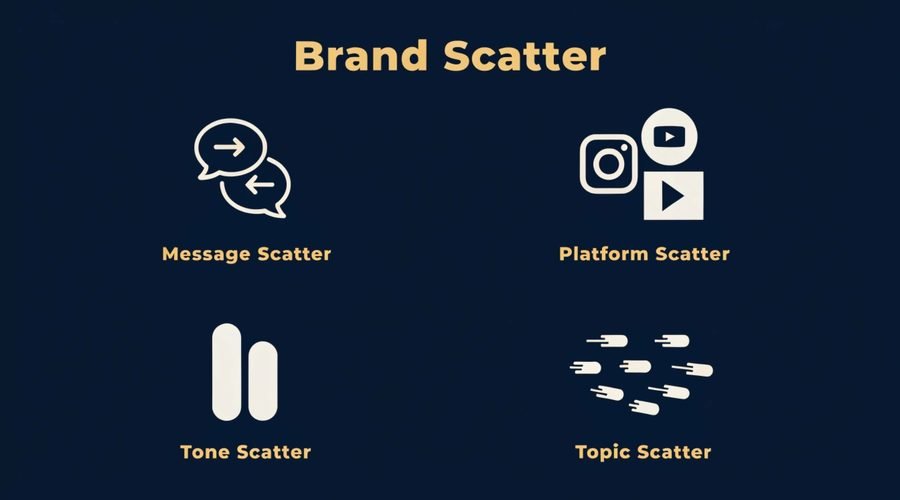
Dimension 1: Message Scatter
Your core promise shifts depending on which channel you are writing for, or which version of yourself showed up that day. On LinkedIn you are the systems thinker. On your newsletter you are the personal brand strategist. On your website you are the growth consultant. The solo consultant who posts motivational content on Monday, technical breakdowns on Wednesday, and personal stories on Friday is not demonstrating range — they are producing an audience that cannot form a coherent picture of what they actually do. Three platforms, three voices, zero brand memory.
Dimension 2: Platform Scatter
You are present everywhere because everywhere felt like the right answer. Instagram because everyone said visual content is the future. LinkedIn because that is where your clients are. A newsletter because you wanted to own your audience. A podcast because you had things to say. Each platform requires its own format, its own rhythm, its own optimization logic — and you are one person. The result: diluted effort, content that is not fully optimized for any single platform's audience, and the perpetual sense that you are spreading yourself too thin without knowing where to cut.
Dimension 3: Tone Scatter
Picture a B2B consultant in Berlin known for methodical, precise thinking. Their website reflects it — careful arguments, structured reasoning, restrained confidence. Their LinkedIn posts are casual, reactive, opinion-heavy. Same person. Two incompatible trust registers. The audience senses the inconsistency before they can name it. They feel that something is off. That vague sense of misalignment is Tone Scatter doing its work — quietly, without leaving a trace the founder can diagnose.
Dimension 4: Topic Scatter
You write about productivity. And content strategy. And leadership. And your industry's latest news. And occasionally your personal journey. Each piece is fine on its own. None of them builds on the last. You are covering too many subjects at insufficient depth to become the recognized authority on any of them.
Any one of these dimensions costs you. All four together make the next section inevitable.
Why 2026 Makes This Worse
Search engines used to reward presence. AI answer engines reward consistency. The two are not the same requirement — and confusing them is expensive.
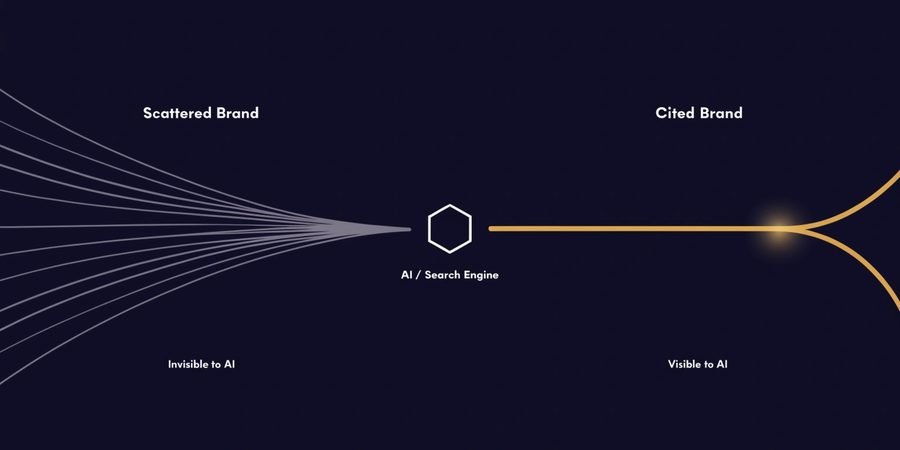
When a potential client opens ChatGPT and asks "what is the best content strategy for a solo founder," they do not receive ten links. They receive a synthesized answer, drawn from sources the system has determined are credible, authoritative, and structurally legible on the topic. Those sources get cited. Everything else does not exist in that interaction.
The signals AI retrieval systems use to determine citation-worthiness are not the same signals that drove traditional search rankings. Backlink profiles and domain rating matter less than they did. What matters now: topical consistency, definitional clarity, and structural legibility. The system needs to be able to associate your brand with a specific area of authority — confidently enough to surface you when asked.
Scatter destroys all three signals simultaneously.
Consider a Scandinavian founder with genuine content expertise — years of work, real depth, substantive thinking. Their newsletter covers content strategy. Their LinkedIn covers personal branding. Their website covers creative direction. Their blog covers industry trends. The knowledge is real. But the AI system cannot associate them with any single topic with enough consistency to cite them as an authority on anything. They are everywhere and nowhere — which is, from a citation perspective, the same as being invisible.
This is not a future problem. It is a 2026 problem.
The visibility cost of scatter is real. The compounding cost is larger — and it's the one that never shows up in the numbers.
The Cost Nobody Calculates
Every scattered piece of content costs you twice: once in the effort to produce it, and again in the authority it fails to build.
Here is how authority actually accumulates. A brand publishes a piece on a specific topic. It is well-structured, consistently voiced, and builds on a clear positioning. The next piece reinforces the same signals. The one after that deepens them. Over time, and with deliberate consistency, the brand becomes associated with that territory in the minds of its audience and in the indexes of AI retrieval systems. Each piece compounds the last.
Now consider the scattered version. A founder publishes five times per week. Strong output, genuine effort, occasionally good individual pieces. But each piece resets the signal. The Monday post on productivity and the Thursday post on personal brand and the Tuesday opinion piece on industry news — none of them reinforce the same authority claim. The audience cannot form a durable association. The AI system cannot build a confident topical signal. Six months of five-posts-per-week produces impressive volume and negligible authority accumulation.
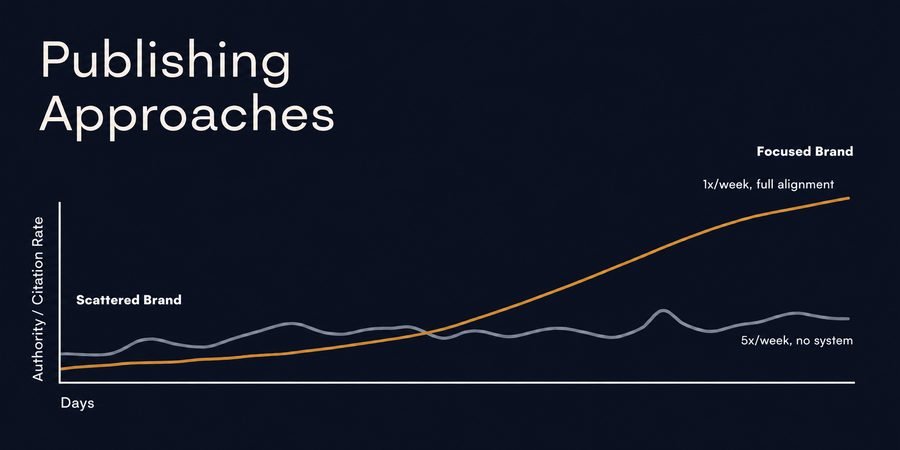
A brand publishing once per week with full strategic alignment — consistent topic, consistent voice, consistent positioning — sends its audience and AI systems the same signal every time. A scattered brand publishing five times per week sends five different ones. Volume doesn't close that gap. Alignment does.
What is actually being lost is not reach. Reach is recoverable. What is being lost is compounding — the invisible accumulation of authority that gives each future piece something to build on, and gives AI systems a reason to connect your name with one topic.
The question is whether you have it, and where.
Diagnose Your Own Scatter
Five questions. Answer honestly. The pattern will be clear.

1. If someone read your last five pieces of content without knowing your name, could they describe what you do in one sentence?
Not roughly. One sentence, specific enough to be actionable. If the answer is no — or if the sentence would differ significantly depending on which five pieces they happened to read — that is Message Scatter.
2. Does your website say the same thing about your positioning as your most recent piece of published content?
Not thematically similar. The same core promise, the same audience, the same authority claim. Inconsistency between your owned platform and your distributed content is easy to miss: each one looks fine on its own.
3. Can you name the one topic area where you are building deeper authority than anyone else in your space, right now?
One. Not three. Not a category. A specific topic that you own — where your name comes up before anyone else's in the conversations your ideal clients are having. If you cannot name it in ten seconds, you do not own it yet.
4. Is the tone of your content consistent enough that a reader would recognize a piece as yours before seeing your name on it?
Voice consistency is not aesthetics. It is trust architecture. Audiences feel the inconsistency before they can articulate it. If your answer is uncertain, it is probably no.
5. When you published your last piece of content, did it build directly on something you published before — or did it stand alone?
Standalone content is not inherently bad. A pattern of standalone content — with no pieces that build on, reference, or deepen previous work — is Topic Scatter in operational form.
Three or more questions where the honest answer is no: that is a scatter pattern. It is not a character flaw. It is a structural condition — diagnosable, measurable, and fixable.
The Scatter Score covers the same ground across five dimensions: the four above, as Message Consistency, Platform Alignment, Voice Coherence, and Topical Authority, plus a fifth, Content Velocity. Seven questions. Your score from 0 to 100 appears on screen as soon as you finish. Your full reading — where the scatter sits, and the one move that matters most — follows by email within 48 hours, written by a person.
Key Takeaways
- Digital Scatter is structural, not creative. Publishing more does not build authority — publishing with architecture does.
- It operates across four dimensions: Message, Platform, Tone, and Topic Scatter. Each one costs authority on its own.
- 2026 raised the stakes. AI answer engines cite sources they can tie to one topic. Scatter makes that tie hard to make.
- The compounding cost is invisible. Every scattered piece resets the authority clock instead of building on it.
- Diagnosis is the first fix. Three or more honest "no" answers in the self-diagnostic section means a scatter pattern is active — and fixable.
References
- What Is Digital Scatter? — ForgeMyBrand Glossary
- The Scatter Score — Free Brand Diagnostic
- Brand Foundation Service
- Content Operating System — ForgeMyBrand Glossary
If scatter is the pattern, the fix isn't more content. It's architecture — and architecture can be rebuilt.