Your content isn't getting rejected. It's getting scrolled past.
No complaint. No unsubscribe note. No reply that says "this isn't for me." Just silence — from the European prospects who opened your newsletter, the international buyers who visited your site, the conference attendees who said they'd follow up. They had your content. They chose not to act on it. You'll never know why.
This is the pattern that doesn't get named: strong engagement in your home market, flat response everywhere else. Same topic. Same quality. Different geography, different outcome. The instinct is to blame distribution, timing, or bad luck. The variable is structural.
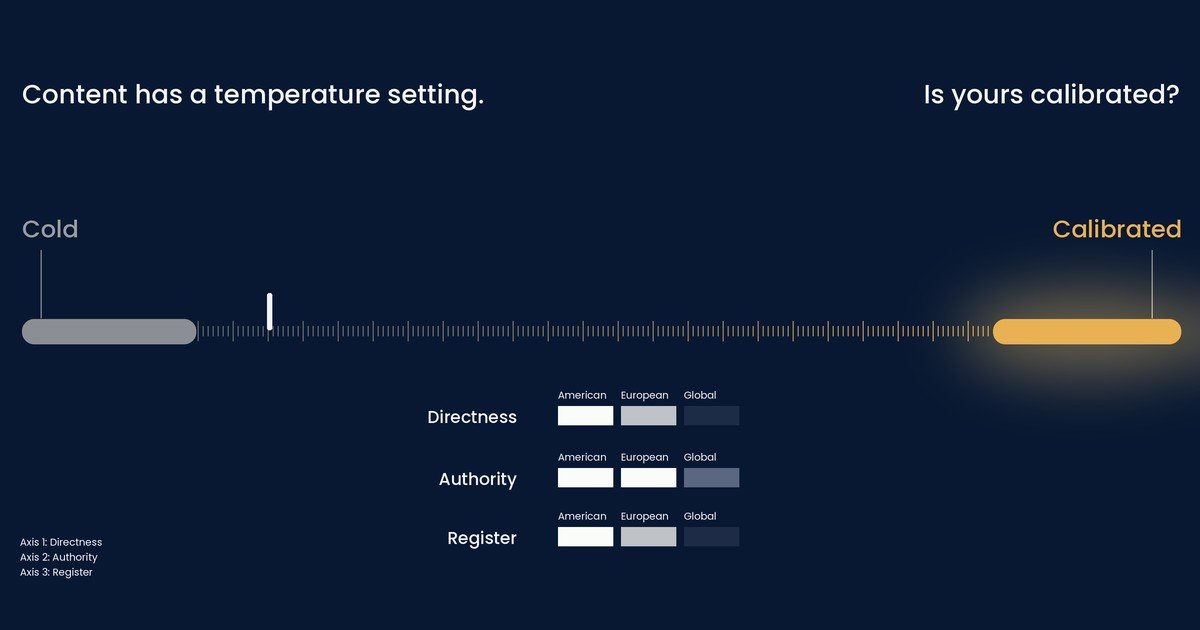
Content Temperature is the degree of cultural and contextual alignment between a piece of content and the audience receiving it. When it's calibrated correctly, your content reads as if written by someone who understands the reader's professional context — not just their problem. When it's off, the reader feels a friction they can't articulate. They don't tell you. They just stop.
Temperature isn't about quality, topic selection, or effort. A well-researched, clearly written piece can have the wrong temperature for a market and fail there silently while succeeding everywhere else. That distinction matters, because the fix is different.
- What Content Temperature Actually Is: Three Axes
- What Happens When the Temperature Is Wrong
- The 40/35/25 Calibration Framework
- Is Your Content Calibrated? Four Questions
What Content Temperature Actually Is: Three Axes
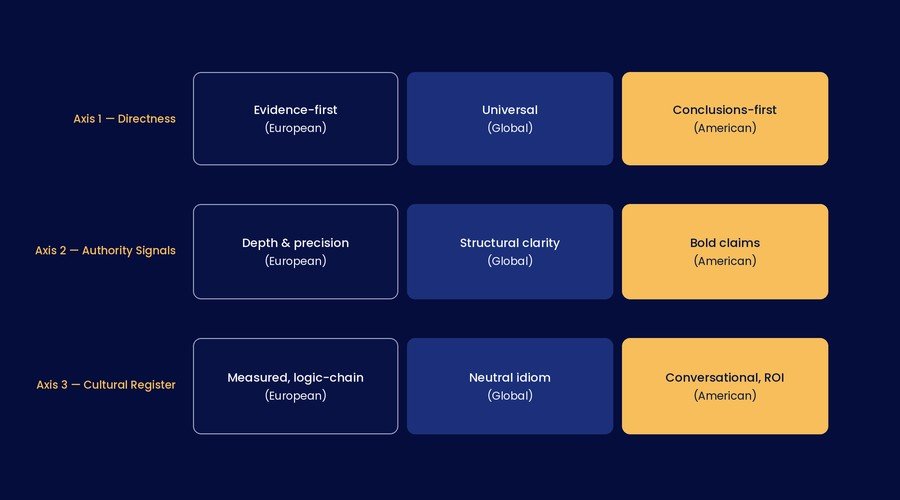
Content Temperature isn't a feeling. It's a structural variable, and it operates across three axes. The full definition lives at the Content Temperature glossary; what follows is the applied argument.
Axis 1 — Directness vs Nuance
American content default: state the conclusion in the first paragraph. Authority is assumed — the writer claims expertise and the reader decides whether to trust it. European content default: earn authority through the argument itself. The conclusion comes after the evidence, not before it. Global default: structure the content so the conclusion is accessible regardless of where a reader enters the piece.
Neither approach is more sophisticated. They're calibrated for different reading conventions. A US reader trained on bottom-line-up-front writing loses patience with a piece that buries its point in paragraph four. A European B2B buyer trained on evidence-first argument becomes skeptical of a piece that opens with a bold claim and fills in the reasoning later. Both readers are right about what they expect.
Axis 2 — Authority Signals
American register: authority through confident assertion, visible social proof, specific results. European register: authority through depth and precision — the specificity of the argument itself signals expertise, not claims about the writer's track record. Global register: structural clarity, defined terms, cited frameworks — the kind of content AI systems are built to extract and cite.
Axis 3 — Cultural Register
American: conversational, action-verb-heavy, ROI-framing visible. European: measured, logic chain visible, longer sentences tolerated when they carry weight. Global: neutral idiom, no region-specific reference, readable by a professional from any Western market without cultural translation.
These are not stereotypes. They're structural defaults — patterns in how content is written, received, and rewarded across markets. Your content doesn't have to match one region's defaults exactly. It has to be calibrated across all three axes with intent.
What Happens When the Temperature Is Wrong
Picture a founder based in Austin who publishes a case study. The writing is clean. The result is specific: a client who reduced churn by 22% after restructuring their onboarding sequence. The headline leads with the outcome. The US audience engages — three LinkedIn comments, a handful of reposts, two inbound inquiries.
Three European enterprise prospects who received the same case study by email never reply.
He checks the open rates. All three opened it. He checks the send time. Fine. He rewrites the subject line and sends a follow-up. Still nothing. The delivery wasn't the problem. The content was.
Not because the case study was weak. Because the authority signals were wrong for the market. The piece opened with the result, then filled in the methodology. For American readers, that structure signals confidence. For European buyers in professional services — where claims are expected to be earned through visible reasoning before they're trusted — the structure read as a sales document, not a proof document. They didn't object. They moved on.
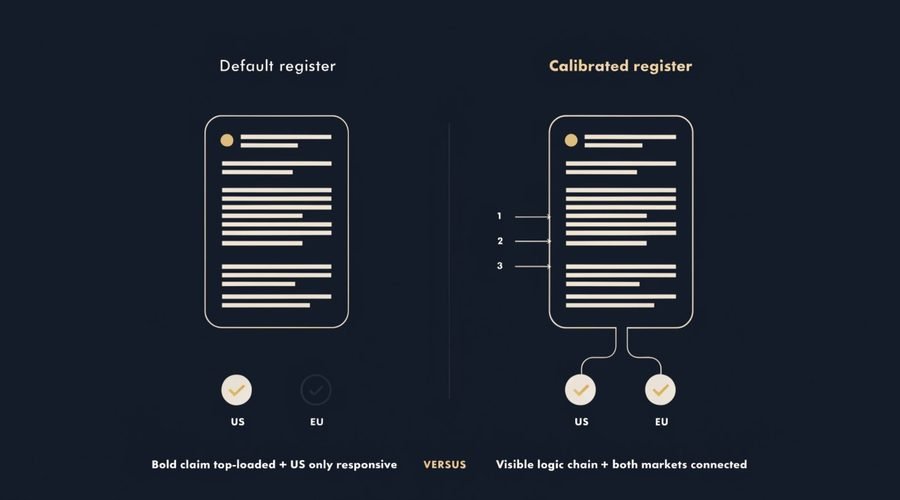
This is the most expensive cost of temperature mismatch: it's invisible. No one tells you the opening was off-register. The silence looks like disinterest in the topic, when it's a calibration problem.
Two other consequences compound the first.
Poor international conversion despite strong reach follows the same pattern. A founder can build a newsletter with 10,000 subscribers across three continents and convert almost exclusively from the market whose default register matches their content. The other readers get the same content and do nothing — not because they don't have the problem, but because the content doesn't feel like it was written for them.
AI citation failure is the third consequence, and the least discussed. AI answer engines — ChatGPT, Perplexity, Google AI Overviews — are structurally agnostic readers. They weigh clarity, hierarchy, and definitional precision above confident claims or cultural authority signals. Content that relies on assumed context, conversational framing, and bold assertions gets passed over for content that defines its terms explicitly, labels its sections clearly, and structures its logic so any reader — human or machine — can follow it without cultural background. Temperature misalignment is a GEO failure mode.
The 40/35/25 Calibration Framework
ForgeMyBrand calibrates content to a specific split: 40% American register, 35% European register, 25% Global register.
That ratio isn't arbitrary. Each share does one job: American register earns the first read, European register earns trust in the argument, and Global register makes the piece legible to international English-speaking readers and to AI answer engines. The split balances reach, conversion, and citation in one piece.
What does it look like in practice?
The American 40% governs the opening and the CTA. The first paragraph states the observation directly — no preamble, no warming up the reader. The CTA is action-oriented and low-friction. The European 35% governs the framework sections — where depth is visible, the logic chain is explicit, and trade-offs are acknowledged rather than glossed over. The Global 25% governs the structural skeleton: labeled sections, defined terms, numbered frameworks, the architecture that makes the piece legible to a reader who arrives without prior context.
Three questions help you find your own split. Where do your highest-value clients come from geographically? Where does your content perform and where does it go silent? What proportion of your pipeline arrives through AI-sourced discovery versus search versus referral?
Calibration is not writing separate versions of your content for each market. It's a single piece that makes structural decisions with intent — where the conclusion lands, how authority is built, which signals appear in which section. One piece of content can carry all three registers if the architecture is deliberate.
Is Your Content Calibrated? Four Questions
You don't need an audit. You need four questions and one piece of your existing content.
Question 1 — Directness (Axis 1): Read your last three opening paragraphs. Do all three state the main point in the first sentence? If not — if they set context first and arrive at the point later — your default register is evidence-first. Check your conversion data by geography. If engagement runs higher in European markets than American ones for the same content, that's the mismatch showing up in the numbers.
Question 2 — Authority signals (Axis 2): Look at the same three pieces. Do they open with a specific result or a bold claim — or do they open with framing and build to the claim? If you're building every time, your authority-signal default is depth-first. Neither is wrong. But pull your reply rates or conversion rates by market. If one geography consistently outperforms another for identical content, the gap is likely here.
Question 3 — Structural legibility (Axis 3): Would a reader who has never encountered your brand understand what you're arguing from your section headings alone? If not, your structural legibility is below Global register. AI systems are less likely to cite you. International readers with no prior context are less likely to trust you.
Question 4 — Overall calibration: Does your content perform differently in different markets for the same topic? If yes, check temperature before you rewrite for quality, change channels, or move the send time.
The four questions give you a first read on temperature. For the wider picture, the Scatter Score is seven questions, with your score on screen. It shows where your message, voice, and platforms pull apart; it does not score register itself. If the gap is how your expert positioning lands across markets, the three-question Situation Diagnostic gets you a path within 48 hours, written by a person. Neither commits you to anything.
Your content isn't underperforming in some markets because it's wrong. It's underperforming because it's calibrated for one audience and broadcasting on that frequency everywhere else.
Key Takeaways
- Temperature is structural, not qualitative. A well-written piece can fail silently in a market because its register is wrong — not because the work is weak.
- It operates across three axes: Directness, Authority Signals, and Cultural Register — each with an American, European, and Global default.
- The cost is invisible. Mismatch shows up as silence: poor international conversion despite strong reach, and AI citation failure — a GEO problem that starts as a register problem.
- Calibrate to 40/35/25. 40% American governs the opening and CTA, 35% European governs the framework depth, 25% Global governs the structural skeleton — one piece, three registers.
- Four questions diagnose your split. Check your openings, your authority signals, your heading legibility, and whether the same topic performs differently across markets.
About the author
ForgeMyBrand builds brand authority systems for solo founders and indie operators. We design the strategy, voice, and quality machinery behind content that compounds, so the standard holds even on your tired weeks.