You've rewritten the hook three times. New format, new template, new tool. The posts still vanish in 24 hours, because the problem was never the posts.
See if this pattern sounds familiar. A flat month triggers a prescription: better hooks, better design, a new AI tool, maybe a $49 swipe file. The next month is flat too, so the dose goes up. More volume, more formats, more effort squeezed between customer calls.
Look closer at what's actually failing, though. Your individual pieces are often fine. Some are genuinely good. What's missing is the compounding: each post lives and dies alone, and nothing connects this week's effort to last month's. Nothing accumulates into a position people remember you for.
That's not a content problem. That's a governance problem. Nothing in your business governs how content gets planned, produced, checked, and improved, so every piece is a one-off decision made by a tired person at a keyboard.
There's a name for the missing layer: a Content Operating System. The short definition lives in our glossary entry; this article is the long one. What it's made of, what breaks without it, and the smallest version you can install this week.
So what is this thing, concretely, and why is it not another template pack?
- What a Content OS Actually Is
- What Content Looks Like Without a System
- The Founder Who Fixed It With a System
- How to Start Building Yours
What a Content OS Actually Is
A Content Operating System is the infrastructure that governs how a brand plans, creates, reviews, publishes, and improves its content.
Read that sentence again. Infrastructure. Not inspiration, not talent, not a bigger content budget. The word matters because infrastructure is the part of a business nobody photographs and everybody depends on. Roads, plumbing, payroll. When it works, it's invisible; when it's missing, everything built on top of it wobbles.
Start with what a Content OS is not, because you've probably bought the imposters. It is not a template library; templates shape single pieces, never the process around them. It is not a posting schedule; a calendar tells you when, but never what, why, or how well. And it is not a prompt collection, because prompts produce output, not standards.
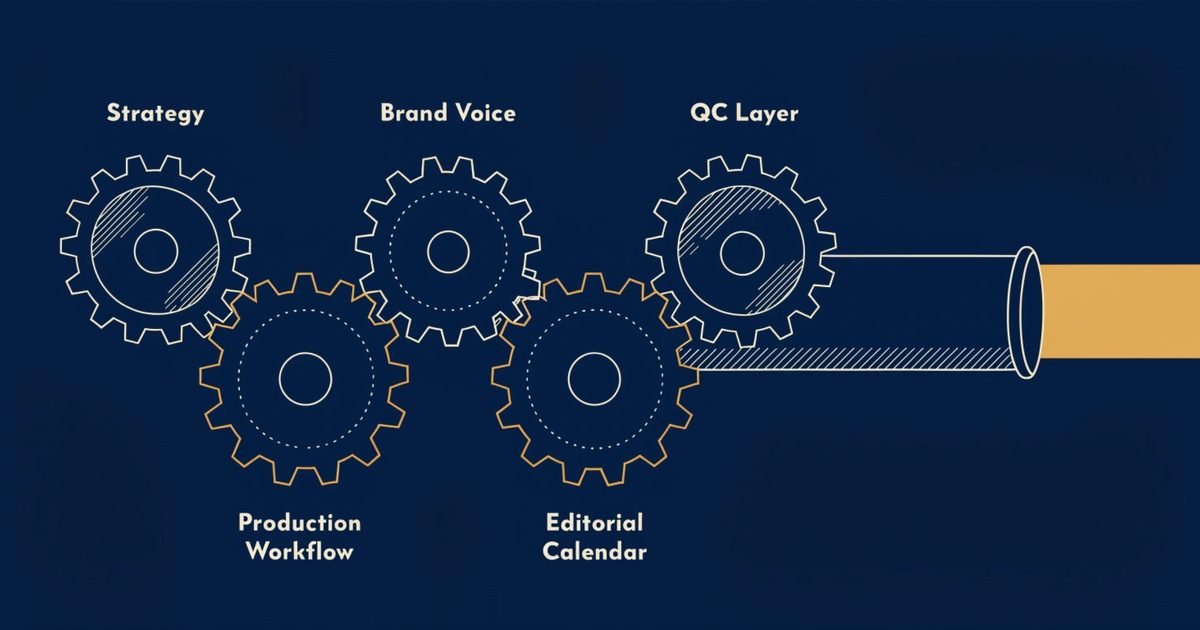
A working Content OS has five components:
- Strategy. The documented answer to who you're for, what you want to be known for, and which questions you exist to answer. Without it, you publish answers to questions nobody asked. Busy, but irrelevant. The cruelest version of failure, because it looks like work.
- Production Workflow. The defined path a piece travels from idea to published, with stages and owners, even if every owner is you. Without one, every piece starts from zero, and zero is the most expensive starting point in content.
- Brand Voice. The written description of how you sound: vocabulary, rhythm, banned phrases, reference pieces. Without it, your blog, your newsletter, and your LinkedIn read like three strangers who happen to share a logo.
- QC Layer. The pass/fail criteria a piece must survive before it ships. Skip it, and quality is whatever you had energy for that day.
- Editorial Calendar. The commitment layer that decides what ships when, independent of mood. Without it, inspiration decides whether you exist this week. Inspiration is a flaky employee.
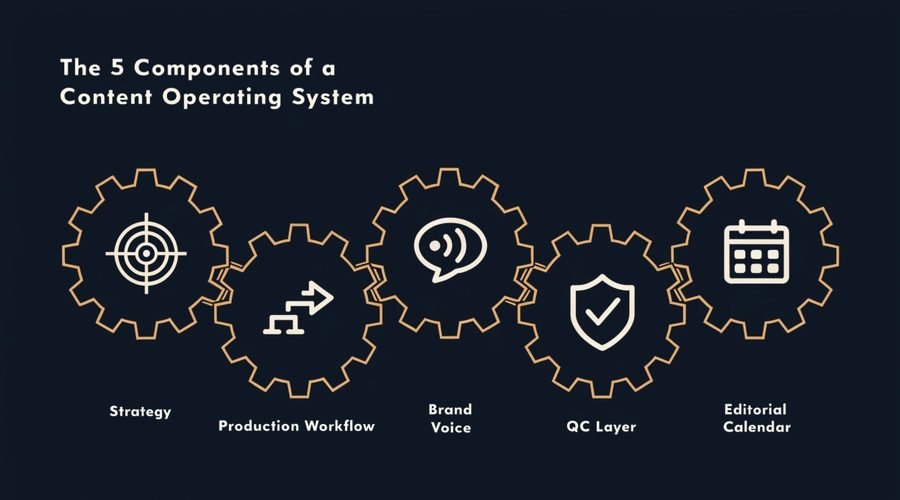
Notice that none of the five is creative. That's the point, and it's the part founders resist. McDonald's doesn't win on the burger; it wins on the operating manual that makes the ten-thousandth burger match the first. The manual does the work a hero can't do every day.
Europeans run a quieter version of the same truth. The German Mittelstand, those unglamorous family firms that dominate narrow markets for decades, runs on process discipline nobody brags about at dinner parties. Documented standards, applied the same way, year after year. No theatrics. Just compounding.
Your content deserves the same boring machinery. If that's the system, this is what its absence looks like from the inside.
What Content Looks Like Without a System
As you read the four, count how many are yours.
Publishing depends on inspiration. Output tracks your mood, not your strategy. A good week produces five pieces; a hard week produces silence, then guilt, then a comeback post about consistency. Your audience can't build a habit around your mood swings, so they don't build one at all. Showing up randomly trains people to expect nothing from you, and they learn fast.
Quality decays as volume rises. The first piece of the week is sharp. The fourth is serviceable. The QC bar lives in your head, and your head gets tired, so the bar drops exactly when nobody's watching. That's how trust erodes: quietly, piece by piece, with no single failure to point at.
Delegation fails on contact. You hire a writer, plug in an AI tool, brief an agency. The work comes back competent and wrong. Wrong voice, wrong angle, wrong feel. Picture a remote operator coordinating a freelancer in Lisbon and an AI tool that never sleeps: both produce mismatched drafts, not because they're bad, but because there was nothing to hand them. No voice document, no criteria, no workflow. The system they needed didn't exist, so they improvised yours, badly.
Improvement is guesswork. With no defined stages and no written criteria, you can't tell which part of the machine failed. The topic? The structure? The distribution? You can't fix what you never specified, so you change everything at once, learn nothing, and call it iteration.
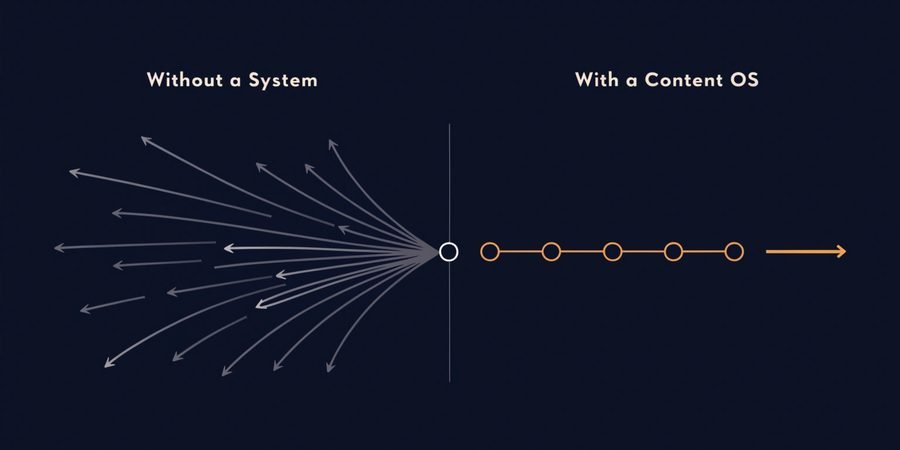
Four symptoms, one disease. An archetype makes the mechanics visible; here's a founder you may recognize.
The Founder Who Fixed It With a System
Picture a founder publishing five times a week. Not lazy, not unskilled. Exhausted, and invisible.
This is an archetype, not a client story, so you'll find no invented revenue chart here. But the shape will be familiar. Five pieces a week across two platforms, every one written from scratch. Sunday nights, 11 p.m., editing a freelancer's drafts back into something that sounds like the brand, which means rewriting them, which means the freelancer was a cost, not a relief. Voice drifting month to month; some weeks the founder reread an old post and didn't recognize the person who wrote it. Volume up, recognition flat. Trust starts when a reader comes back for a second piece; this founder never got the same reader to piece two.
The intervention was boring on purpose. Not a rebrand, not a new channel, not doubling down to ten pieces a week. Two documents.
The first: a one-page voice guide. How the brand sounds, what it never says, and three reference pieces that define the standard.
The second: a QC checklist. Five written pass/fail questions every piece must survive before it ships.
Two components out of five. That's the whole intervention.
Here's what changes, mechanically. Pieces now pass or fail against written criteria instead of mood. The freelancer's next draft comes back sounding like the brand, because the brand is finally written down somewhere a stranger can read it. The founder's Sunday job shifts from rewriting to reviewing: a checklist pass instead of an evening with a blank stare.
And the standard holds on the tired weeks. That's the real prize. Consistency stops depending on the founder's energy, because the system holds the bar so the founder doesn't have to. The brand keeps its voice even when its owner loses theirs for a week. Sunday night looks different too: checklist closed, coffee still warm.
You don't need all five components to start. You need the two that stop the bleeding.
How to Start Building Yours
Forget the full build. The minimum viable Content OS is two documents and one decision.
The two documents, written this week:
Your Brand Voice page. One page, no more: how you sound in plain words, the phrases you ban, and links to three existing pieces that already sound like you. Imperfect is fine. Written beats remembered. A mediocre standard on paper outperforms a brilliant standard in your head, because paper doesn't get tired.
Your QC checklist. Five pass/fail questions every piece must survive. For example: Does this answer a question my audience actually asks? Would I say this sentence out loud? Does it match the voice page? Is there one specific detail a competitor couldn't copy-paste? Is the reader's next step obvious? Pilots and surgeons run checklists precisely because memory and mood fail under load; your publishing brain is no different on a Thursday afternoon.
Run your next piece through both before it ships. That single act, a written standard applied once, is the moment you stop having content and start having a system. And if you'd rather have the full machine designed for you, that's what our content engine service is built for.
The one decision, made this month: add the third component your situation actually needs. Strategy, if you never know what to publish. Production Workflow, if every piece exhausts you. Editorial Calendar, if consistency is the gap. Pick one, not all three; systems built in a weekend get abandoned by Tuesday.
Not sure which gap is yours? Take the seven-question Scatter Score to see where your content is leaking attention; your score appears on screen as soon as you finish. If you'd rather start from your situation than your score, the three-question Situation Diagnostic sends you a recommended path within 48 hours, written by a person. Neither commits you to anything.
The next piece you publish can be the first one your system produced.
Find Your Content Leak — Free Scatter Score →
Key Takeaways
- It's a system problem, not a content problem. Individual pieces are often fine; what's missing is the governance that makes them compound.
- A Content OS has five components: Strategy, Production Workflow, Brand Voice, QC Layer, and Editorial Calendar — none of them creative.
- Without a system, four symptoms appear: output tracks mood, quality decays with volume, delegation fails, and improvement is guesswork.
- You don't need all five to start. A one-page voice guide and a five-question QC checklist are the two that stop the bleeding.
- Then add one more component — the one your situation actually needs — and run your next piece through the system before it ships.
About the author
ForgeMyBrand builds brand authority systems for solo founders and indie operators. We design the strategy, voice, and quality machinery behind content that compounds, so the standard holds even on your tired weeks.