Key Takeaways
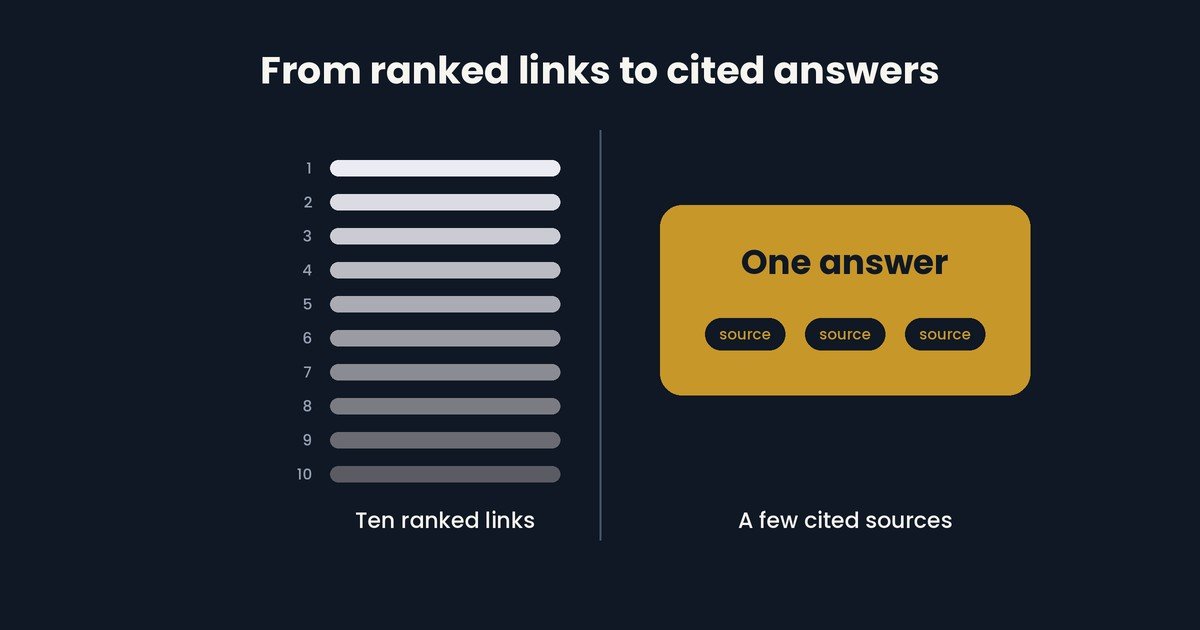
- The scoreboard changed: AI answer engines synthesize one answer with a handful of cited sources. If you’re not in the synthesis, you’re absent — not just outranked.
- GEO-First Content is built from the ground up to be retrieved and cited by AI engines, organized around four signals: Clarity, Structure, Depth, and Authority.
- Traditional expert content fails because the answer is buried, headings set mood instead of stating content, and pieces stand alone — fog to a retrieval system.
- The work rests on four pillars: Definitional Clarity, Structural Legibility, Topical Depth, and Citation Architecture.
- Start with one piece: a single definitional asset (first-sentence answer, labeled sections, a numbered framework, linked into a cluster) — then run the three-question self-check.
Ask ChatGPT the question your best customer asks right before they buy. Read the whole answer. Now check whether you’re in it.
From Ranked Links to Synthesized Answers
For years, the deal with search was simple. Write well, earn links, climb the rankings, collect the clicks. Ten blue links, and your job was to be one of them. That scoreboard still exists. It just stopped being the only one that decides who gets found.
AI answer engines — ChatGPT, Perplexity, Google AI Overviews — don’t return ten links. They synthesize one answer. The user asks, the engine reads, and a single response comes back with a few sources woven into it. There’s no page two. There isn’t even a page one. There is the answer, and there is everything the answer left out.
If you’re not in the synthesis, you don’t exist in that interaction. Not demoted. Not outranked. Absent.
And here’s how it can show up: rankings stable, traffic fine, and inbound from search quietly slipping while the dashboard explains little. Your buyers may not have stopped asking questions. Some started asking them in AI answer engines, which your usual reports only partly capture — and where your content, as currently built, may not be cited.
What GEO-First Content Actually Is
GEO-First Content is content designed from the ground up to be retrieved and cited by AI answer engines. That’s the full definition, and its placement is deliberate: first sentence, directly extractable, no wind-up. The short version lives in our glossary entry; this article is the long one.
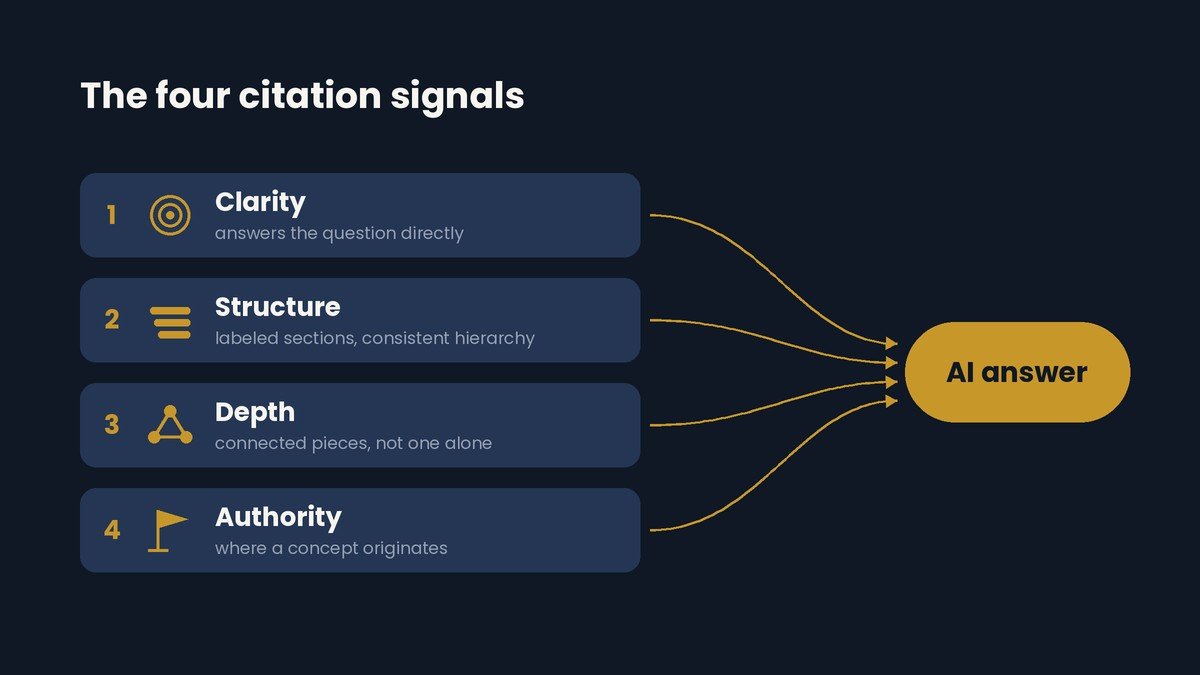
GEO stands for Generative Engine Optimization — the discipline of earning a place inside synthesized answers rather than on ranked lists. When an engine assembles an answer, it decides which sources to pull from and which to credit. No engine publishes its selection rules. This article groups what engines appear to reward into four signals:
- Clarity — the content answers the question directly, in liftable form, instead of circling it for six paragraphs.
- Structure — labeled sections and consistent hierarchy that let a machine see where one idea ends and the next begins.
- Depth — real topical coverage across connected pieces, not one clever take floating alone.
- Authority — being the place where a concept originates, not one of forty places commenting on it.
It’s worth being blunt about what GEO-First is not, because the category is filling up with noise. Not a rebranded SEO retainer. Not keyword stuffing with extra steps. Not another tracker subscription. It’s a structural discipline: the expertise you already have, arranged so the systems doing the citing can actually read it. If that sounds suspiciously simple, good — the mechanism is simple. The work is in applying it before someone else claims your ground.
Why Traditional Content Fails in the AI Era
Your best article probably deserves to be cited. Structurally, it may be unreadable to the system doing the citing.
A lot of expert content was built for a patient human who starts at the top. So the answer lands in paragraph six, after the scenic wind-up. Headings set a mood — “A different way to think about it” — instead of stating content. The piece stands alone, linked to nothing else on the domain. For a reader with coffee and time, that’s style. For a retrieval system scanning for an extractable answer, it’s fog.
Positioning fails the same way. Content that reacts to concepts — our take on X, what everyone gets wrong about Y — tends to lose to content that defines them. Engines tend to cite origins. Commentary, however sharp, points away from you.
The old authority math shifted too. Backlinks still count for something, but a decade of link-building can lose a citation to a newer domain that simply covers the territory in connected depth. That stings. It’s also the opening: connected depth is something any domain can build.
One objection deserves a straight answer first: doesn’t restructuring for machines mean degrading the writing? No — and the before/after below shows why. Structure is what good editors demanded long before AI existed: say the point, label the sections, connect the work. Good technical writing has run on that discipline for generations without losing its prose. Legibility isn’t a tax on quality. It’s craft.
The 4 Pillars of GEO-First Content
Four pillars, numbered, each mapped to the signal it satisfies. This is the section to screenshot.
01. Definitional Clarity
What: Answer the question in the first sentence of the section that owns it. Why: Retrieval systems look for direct answers and favor them over buildup — clarity is the first signal, and it starts at the sentence level. Apply it: Take your three most important pages and rewrite each key section to open with its answer. The supporting argument stays; it just moves below the point instead of in front of it.
02. Structural Legibility
What: Labeled H2s that state their content, numbered frameworks, consistent hierarchy. Why: Structure helps engines see meaning boundaries — a heading that says “The 4 Pillars of GEO-First Content” is machine-readable in a way “Building on solid ground” isn’t. Apply it: Read only your section titles. If a stranger couldn’t reconstruct the article’s argument from them alone, the structure is decorative, not load-bearing.
03. Topical Depth
What: Clusters of interlinked pieces covering one territory — a definition page, a depth article, an application piece — instead of isolated essays. Why: Depth across a connected cluster beats brilliance in isolation; engines appear to weigh whether a domain covers a topic, not only whether one URL is good. Apply it: Map your core concept to at least three linked pieces. Building that cluster deliberately is what a content engine is for, but the principle costs nothing to start applying.
04. Citation Architecture
What: Be the origin of named concepts, not the commentator on someone else’s. Why: Engines tend to cite where a term is defined, and definitional ground claimed early tends to be hard to displace — the compounding works much like SEO authority did, with fewer seats. Apply it: Name your frameworks. Define them on your own domain first, before the post that popularizes them. That’s what expert positioning means in practice: owning the vocabulary your market ends up using.
What GEO-First Looks Like in Practice
Picture a consultant in Amsterdam — call her Elena (a pattern, not one real person). One quiet afternoon, half out of curiosity, she typed into Perplexity the exact question her best essay answers — the piece she’d spent a decade earning the authority to write. The engine returned a clean, confident answer and credited two competitors whose content she knew to be thinner. Her essay, the deepest treatment of the subject anywhere, went unmentioned. She’d broken none of the rules she’d been taught. That was the part that stung.
Before — the same essay, as published: the answer arrives in paragraph six, after a graceful wind-up. The headings read “A quieter kind of leverage” and “Where most advice goes wrong.” Lovely for humans. Opaque to retrieval. No numbered framework, though the thinking inside is systematic. No links to or from anything else she’d written on the topic.
After — the same essay, restructured: her definition now opens the piece, one clean sentence. Headings state their content. The method she’d described loosely across two thousand words became a named, three-part framework with numbers on it. The essay links to a short definition page and a client-application piece, and both link back.
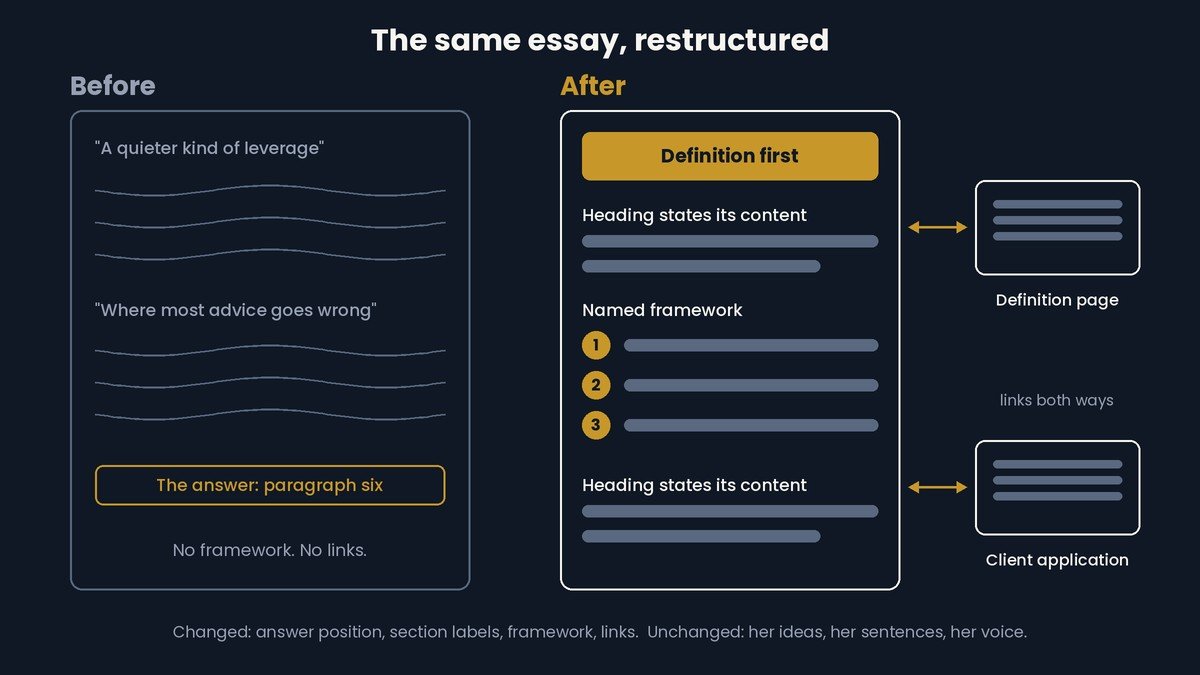
Count what changed: position of the answer, labels on the sections, a name and numbers on the framework, links closing the cluster. Now count what didn’t: her ideas, her sentences, her voice. The gap was never qualitative. It was structural — and structure can be fixed far faster than expertise can be built.
How to Start
You don’t restructure two hundred posts. You start with one: the minimum viable GEO-First piece is a single definitional asset on the concept you most want to own — first-sentence answer, labeled sections, a numbered framework, linked into whatever related content you already have. One piece, assignable this sprint.
Before that, run this three-question self-check on your current best article. Alone, honestly, two minutes:
- Does it answer its core question in the first two sentences? If the answer is buried below the wind-up, it’s easy for retrieval to miss (Pillar 01).
- Could the section titles alone tell a stranger what each section says? If your headings set mood instead of stating content, the structure isn’t load-bearing (Pillar 02).
- Does it link to and from at least two related pieces on your domain? If it stands alone, it’s brilliant in isolation and weak in depth (Pillar 03).
Two or three no’s means structure is likely what keeps your content out of citations, however good it is — which, read the right way, is encouraging: the fix is mechanical. And ground claimed early compounds quietly for whoever takes it.
If the self-check leaves you wanting a second reading, there are two free options. The Scatter Score is seven questions, and your score appears on screen; it shows where your message, voice, and platforms pull apart, and it does not measure citation readiness. The Situation Diagnostic is three questions; a person reads your answers and writes you a path within 48 hours. Neither commits you to anything.
The longer a concept goes undefined on your domain, the more room someone else’s definition has to become the one the engines repeat.
Sources / Further Reading
Aggarwal et al., “GEO: Generative Engine Optimization” (KDD 2024) · Google Search Central: AI features and your website · Perplexity Help Center: How does Perplexity work? · GEO-First Content (glossary)
Read next
Why Your Brand Is Loud Everywhere and Remembered Nowhere · You Don’t Have a Content Problem. You Have a System Problem. · Scatter Score: find where your content is leaking attention
What is GEO-First Content?
Content designed from the ground up to be retrieved and cited by AI answer engines. GEO stands for Generative Engine Optimization — earning a place inside synthesized answers rather than on ranked link lists.
How is GEO different from SEO?
SEO competes to be one of ten ranked links; GEO earns a place inside a single synthesized answer. Engines tend to reward clarity, structure, depth, and being the origin of a concept rather than a commentator on it.
What are the four pillars of GEO-First content?
Definitional Clarity, Structural Legibility, Topical Depth, and Citation Architecture — each mapped to one of the four citation signals.
How do I start with GEO-First content?
Build one definitional asset on the concept you most want to own — first-sentence answer, labeled sections, a numbered framework, linked into a cluster — and run the three-question self-check on your current best article.